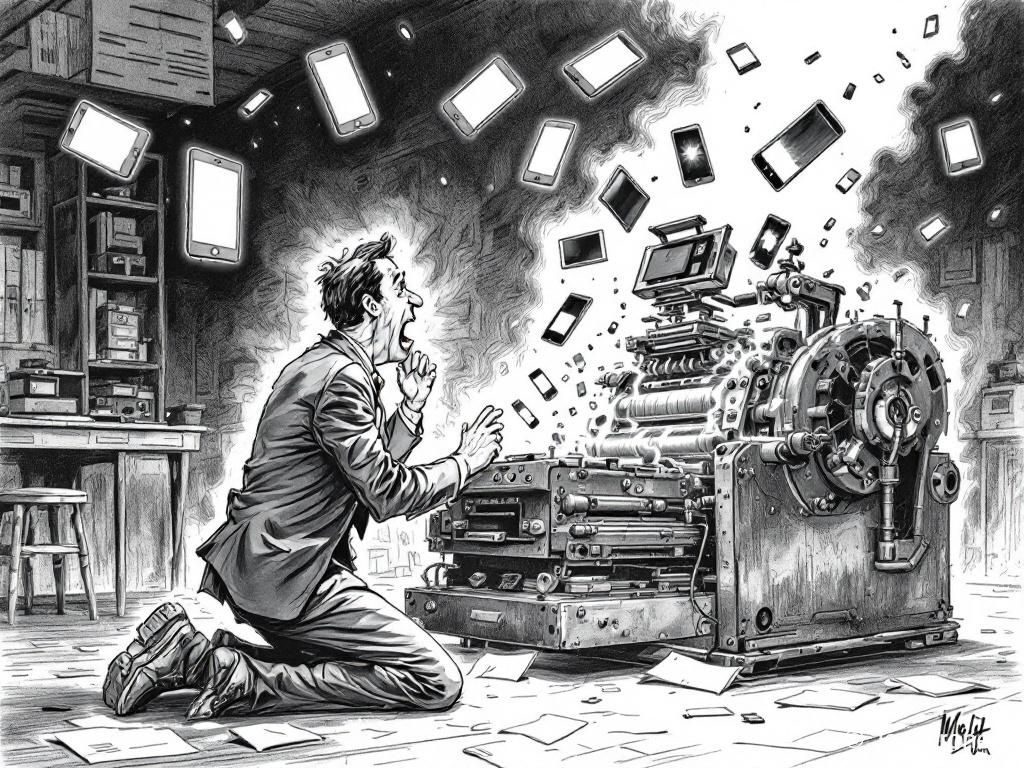
The holidays gave me space to reflect on 2025 and think about what I want to be different in 2026. One thing kept surfacing, a problem I’ve been circling for years but haven’t said plainly.
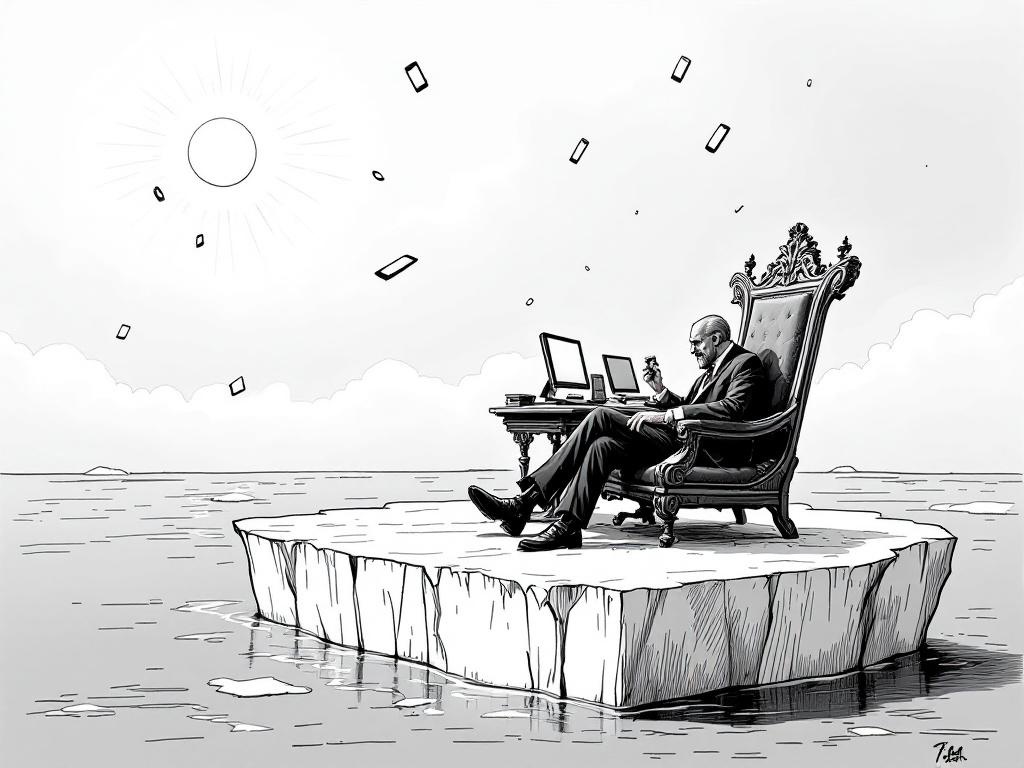
I’ve spent twenty years watching media companies commit suicide in slow motion.
That’s harsh, but it’s accurate. At the Associated Press and The Washington Post I have led product and technology for their B2B media workflow software businesses, serving many of the largest broadcasters, digital publishers, and newspapers around the world. That has given me a front-row seat to how this industry actually behaves—both inside my parent companies and across their customers.
My background isn’t typical for a media executive. Computer science degree, Microsoft during the dot-com boom, tech startups, a Wharton MBA, executive roles at non-media SaaS businesses. I came to this industry as an outsider and never fully stopped being one. That outside perspective showed me something most people in this industry don’t want to admit: we did this to ourselves.
Over the last year I have been talking about “Audience 3.0” in almost every room I enter: INMA, NAB, IBC, and WAN-IFRA stages, webinars with hundreds of digital publishers, and off-the-record sessions with media executives who feel their products drifting out of sync with reality.
The pattern is brutally simple: audiences have moved on, organizations have not.
The following is how I would describe the root problems, and what we can do about it. This is just me talking, not my employer or anyone else. My resolution for 2026 is to share my thinking more openly, and this is the first of what I hope will be many posts.
The Seven Ways We Broke Ourselves These are systemic behaviors, not personal attacks. Very good people are stuck acting them out because the structure gives them almost no other option.
1: Monopoly Complacency came first. For decades, media brands operated as protected monopolies and assumed audiences and cash flows were guaranteed. That comfort killed urgency. The ambitious technical talent left for other industries long before the internet arrived because there was no incentive to change anything.
2: Managed Decline as Strategy followed naturally. I’ve sat in rooms where executives openly discuss preserving the institution instead of pursuing bold reinvention. Leadership behaves as if the business is already terminal, optimizing for pension obligations and cost protection rather than building new models. The tragedy is that growth opportunities exist—I’ve seen them up close. Businesses that look a bit different from the legacy model, that serve adjacent markets or newer audiences. But the system ignores them, underinvests in them, or actively undercuts them to protect the core. They’ve drifted toward a charity mindset instead of a commercial one.
3: Frozen Structures and Hostile Relationships make everything worse. Job definitions and labor agreements lock in workflows designed for a page-based, edition-based, broadcast era. Line staff and executives relate to each other with open suspicion. Staff see leadership as out of touch and disposable. Leadership sees staff as blocking change. Even good ideas die on contact with the organization.
4: Leadership Vacuum and Mission Drift compound the problem. A small circle of executives rotates across similar institutions, carrying the same assumptions from one brand to another. They mistake managing each other for leading their organization. Firms speak publicly about democracy and civic duty while much of the daily work is low-leverage production and copy polish. The gap between the mission on the wall and the work on the desk corrodes morale and makes it impossible to attract transformative talent.
5: Zombie Innovation Spending has burned through hundreds of millions in precious capital. Media companies spend heavily on technology but mostly on trend-chasing: CMS rewrites, app relaunches, paywall pivots, video pivots. I’ve watched organizations convince themselves they’re commercial software companies, investing in custom builds that have nothing to do with their actual competitive advantage. The opportunity cost is staggering, every dollar and hour spent on the wrong thing is one not spent understanding the audience.
6: Product Timidity and Format Blindness keep us stuck. Roadmaps focus on incremental improvements to articles and homepages instead of building formats native to feeds, streams, and chats. Teams imitate the surface of modern products—cards, infinite scroll—without adopting feed logic or creator-centric storytelling. The result is nicer versions of yesterday’s containers that still feel out of place next to where Audience 3.0 actually lives. Few media companies have truly reinvented their workflows—strip away the styling and the digital versions look an awful lot like the formats from before the internet.
7: Commercial Surrender to Platforms sealed our fate. Search and social platforms captured the critical levers: identity, targeting, measurement, buying tools. Programmatic systems treat premium journalism as interchangeable inventory at commodity prices. We kept the cost of content production but lost most of the value it creates.
Here’s the thing: we committed these sins. Which means we can choose differently.
Three Resolutions For 2026 That Actually Matter Resolution One: Lead with Radical Honesty
Name managed decline and legacy baggage in plain language. In the boardroom, with teams, and face to face at every level of the organization—not through memos or town halls where hard truths get softened into nothing. Frame it as “we built this system, we can change it,” not “the world did this to us.” Replace survival goals with forward-looking ones: new audiences reached, new formats launched, new revenue lines created.
This addresses the complacency, managed decline, frozen structures, and leadership vacuum all at once. It’s about moving from stewards of a dying model to leaders who admit what went wrong and choose to build something different. If your culture has trained people to avoid direct communication, Kim Scott’s Radical Candor is a good place to start rebuilding that muscle.
Resolution Two: Reclaim Our Value
The journalism and cultural authority we produce has enormous value. We let platforms capture most of it. Reclaiming that value means building direct relationships with audiences and advertisers that don’t run through someone else’s ad stack.
But first we need to be honest about what we actually offer. Media is not a fact-checking machine or an answer engine. We provide a mix of entertainment, trusted information, community, and perspective. Identify what we have that cannot be commoditized: expertise, access, trust, community. Make that the center of our business model, not an afterthought bolted onto programmatic revenue. This isn’t about “more subscriptions.” It’s about standing behind the unique value media creates and pricing it accordingly.
Resolution Three: Earn Our Audience Back
Stop assuming people should come to us because of legacy or mission. Earning them back means genuinely understanding how they live now, not how we wish they lived. Building products native to feeds, streams, and conversations. Respecting their time enough to be useful, not just important.
This is not a product problem or an editorial problem or a commercial problem. It requires all three working together: new products, evolved storytelling standards and workflows, commercial models that chase where the puck is headed, and real investment in our own brands to attract new audiences in ways that communicate unique value.
In my language, it means finally designing for Audience 3.0: creator-led, feed-first, and LLM-fluent. Not pretending we can drag people back to old habits.
What Inspires Me Going Into 2026 We built the system that led us here. The good news is that means we can build a new one.
I reject the lazy judgment that paints this new audience as shallow or incapable of sustained attention. What I see is a generation that adapted to multiple screens, constant alerts, nuance, creativity, and a healthy disregard for brand names that haven’t earned their trust.
Audience 3.0 isn’t the enemy of journalism. It’s the reality we must design for if we want journalism to matter in the next fifty years, not just the last fifty.
If you’re a media leader, product builder, journalist, or investor, I’d love to hear where this matches what you’re seeing—and where you disagree. This conversation needs to move from conference stages into board agendas and roadmaps this year, or the decisions will be made for us by others.
—
Disclaimer: The views expressed in this post are entirely my own and do not represent the positions, strategies, or opinions of my current employer, any of the thousands of media organizations I have served as customers, or any company or institution I have been affiliated with in the past.